The 2014 Corvette Stingray Forum
News / Blog Register Community Calendar Today's Posts Search

Go Back   Chevrolet Corvette Stingray C7 Forum > Members Area > General Automotive + Other Cars Discussion

Reply
 
Thread Tools
Old 07-25-2010, 04:40 PM   #15
Mr Twisty


Mr Twisty's Avatar
 
Drives: the 2nd amendment home
Join Date: May 2008
Location: OK
Posts: 14,763
Quote:
Originally Posted by topgun1 View Post
I love the 454 engine. If I ever get a 69 chevelle SS, I want that engine in it!

thanks for all the info to all, but still....what are the actual specifications that make a block a "big block"? is it a very blurry line or a fine line--i.e. certain bore and stroke, certain displacement, liter, etc.
DGthe3 gave good technical info on 'why'.... If you understand deck height and bore spacing you'll understand.
__________________
"They that can give up essential liberty to obtain a little temporary safety deserve neither liberty nor safety."
-- Benjamin Franklin

lib·er·ty
/ˈlibərdē/
noun
1.
the state of being free within society from oppressive restrictions imposed by authority on one's way of life, behavior, or political views
Mr Twisty is offline   Reply With Quote
Old 07-25-2010, 04:55 PM   #16
Mr Twisty


Mr Twisty's Avatar
 
Drives: the 2nd amendment home
Join Date: May 2008
Location: OK
Posts: 14,763
Bore diameter and crank stroke determine cubic inches (and cubic litres).

Simplified, do this... take 4 pennies and line them side by side in a row. Then do the same with quarters. That can represent your difference in bore size and spacing.
__________________
"They that can give up essential liberty to obtain a little temporary safety deserve neither liberty nor safety."
-- Benjamin Franklin

lib·er·ty
/ˈlibərdē/
noun
1.
the state of being free within society from oppressive restrictions imposed by authority on one's way of life, behavior, or political views
Mr Twisty is offline   Reply With Quote
Old 07-25-2010, 05:17 PM   #17
DGthe3
Moderator.ca
 
DGthe3's Avatar
 
Drives: 05 Grand Am GT
Join Date: Jul 2007
Location: Niagara, Canada
Posts: 25,366
Send a message via MSN to DGthe3
Quote:
Originally Posted by MisterCamaro69 View Post
DGthe3 gave good technical info on 'why'.... If you understand deck height and bore spacing you'll understand.
Suppose I should explain those things then ...

Bore spacing is the distance between the centerlines of the cylinders. This isn't to be confused with cylinder bore, which is the diameter of the cylinder. It is the main factor in how big of a bore your engine can safely have.

Deck height is the distance from the centerline of the crank to the top of the deck (where the heads meet the block). This determines the amount of stroke an engine can have (distance the pistons travel).

Together, bore and stroke determine total engine displacement.
__________________
Note, if I've gotten any facts wrong in the above, just ignore any points I made with them
__________________
Originally Posted by FbodFather
My sister's dentist's brother's cousin's housekeeper's dog-breeder's nephew sells coffee filters to the company that provides coffee to General Motors......
........and HE WOULD KNOW!!!!
__________________

Camaro Fest sub-forum
DGthe3 is offline   Reply With Quote
Old 07-25-2010, 05:52 PM   #18
Mr Twisty


Mr Twisty's Avatar
 
Drives: the 2nd amendment home
Join Date: May 2008
Location: OK
Posts: 14,763
Quote:
Originally Posted by DGthe3 View Post
Suppose I should explain those things then ...

Bore spacing is the distance between the centerlines of the cylinders. This isn't to be confused with cylinder bore, which is the diameter of the cylinder. It is the main factor in how big of a bore your engine can safely have.

Deck height is the distance from the centerline of the crank to the top of the deck (where the heads meet the block). This determines the amount of stroke an engine can have (distance the pistons travel).

Together, bore and stroke determine total engine displacement.
I figured the coin deal would help simplify bore spacing since larger diameter needs larger spacing.... in this example anyways.

The only 'stroke' metaphor I came up with was X rated.

You COULD give the history of the chevy small block, and THEN go on to the mystery motor and development of the big block.... in detail

... oh yeah... and maximum bore and stroke, along with their displacements, for each block.... or recommend a good book instead of write one.
__________________
"They that can give up essential liberty to obtain a little temporary safety deserve neither liberty nor safety."
-- Benjamin Franklin

lib·er·ty
/ˈlibərdē/
noun
1.
the state of being free within society from oppressive restrictions imposed by authority on one's way of life, behavior, or political views
Mr Twisty is offline   Reply With Quote
Old 07-25-2010, 05:55 PM   #19
Jicata
Banned
 
Drives: 2011 Mustang GT 305 Boss
Join Date: Jul 2010
Location: Miami, Florida
Posts: 118
Cubic Inches.
Both my cars are small blocks.
Camaro = 376
Mustang = 305
Jicata is offline   Reply With Quote
Old 07-25-2010, 07:11 PM   #20
topgun1

 
topgun1's Avatar
 
Drives: 10 SIM 2SS/RS LS3
Join Date: May 2008
Location: Winston-Salem, NC
Posts: 1,939
Quote:
Originally Posted by MisterCamaro69 View Post
I figured the coin deal would help simplify bore spacing since larger diameter needs larger spacing.... in this example anyways.

The only 'stroke' metaphor I came up with was X rated.

You COULD give the history of the chevy small block, and THEN go on to the mystery motor and development of the big block.... in detail

... oh yeah... and maximum bore and stroke, along with their displacements, for each block.... or recommend a good book instead of write one.

much appreciation on the explanation. At least I'm glad I already knew the difference between bore spacing and bore diameter though to begin with but deck height was a new term to me, although I know stroke.
__________________
5th Gen Camaros of the Carolinas SIM, 2SS/RS LS3 5/7/11 453.9 RWHP 427.5 RWTQ
VMS Stage 2.5 Comp Cams kit, Cold Air Inductions intake, ADM race scoop, DT 1 3/4" headers, Solo cats, 3" Magnaflow catback, Pypes cutouts, HP tune, H&R SuperSport springs, Eibach sways/spacers, TexasSpeed UD pulley, LSR tensioner pulley, Barton shifter, skip shift eliminator, powder-coated calipers, R1 concept rotors, StopTech pads, Granatelli wires, Lloyds mats, tint, AAC afterburner taillamps, AAC scanner/sidemarkers, SRP pedals, custom engine cover, black bowties, Ridergraphix hood spears....
topgun1 is offline   Reply With Quote
Old 07-25-2010, 07:14 PM   #21
DGthe3
Moderator.ca
 
DGthe3's Avatar
 
Drives: 05 Grand Am GT
Join Date: Jul 2007
Location: Niagara, Canada
Posts: 25,366
Send a message via MSN to DGthe3
Quote:
Originally Posted by Jicata View Post
Cubic Inches.
Both my cars are small blocks.
Camaro = 376
Mustang = 305
Has nothing to do with displacement. There are 7L small blocks (427 cu) and there were 348 cu big blocks (5.7L).
__________________
Note, if I've gotten any facts wrong in the above, just ignore any points I made with them
__________________
Originally Posted by FbodFather
My sister's dentist's brother's cousin's housekeeper's dog-breeder's nephew sells coffee filters to the company that provides coffee to General Motors......
........and HE WOULD KNOW!!!!
__________________

Camaro Fest sub-forum
DGthe3 is offline   Reply With Quote
Old 07-25-2010, 07:23 PM   #22
Mr Twisty


Mr Twisty's Avatar
 
Drives: the 2nd amendment home
Join Date: May 2008
Location: OK
Posts: 14,763
Quote:
Originally Posted by topgun1 View Post
much appreciation on the explanation. At least I'm glad I already knew the difference between bore spacing and bore diameter though to begin with but deck height was a new term to me, although I know stroke.
Here's a nice short writeup about the big block from Super Chevy magazine...

Quote:
Mark IV Big Block Chevy Engine - The Mark of Chevy Power
Where Chevy Muscle Really Lives
From the July, 2006 issue of Super Chevy
By Paul Zazarine
Photography by Courtesy of GM
Chevy Mark Iv Big Block Motor 1965 Corvette L78
"Porky" Pine rides atop the Mark IV '65 Corvette L78.

The legend began on the high banks of Daytona in February 1963. A handful of Chevrolets arrived for the Daytona 500 with something "mysterious" under the hood. While Ford and Chrysler expected to compete against Chevrolet's venerable "W" head 409, the Bow-Tie guys had a rather large surprise waiting for them. As Junior Johnson's Chevy thundered around the track at speeds in excess of 160 mph, every soul from the garages, to the pits, to the stands knew that was no W block. Hot on Junior's heels was Johnny Rutherford in another Chevy. The Chevrolets of Ray Fox, Smokey Yunick, and Bubber Farr all ran with power unmatched by the 409, and Ford and Chrysler cried foul. What was this "mystery motor" that Chevrolet was running?

Inside Chevrolet Engineering, it was called the Mark II, a 427ci V-8 that had no bloodline with the 409, which was dubbed the "Mark I." The word "Mark" was derived from the European tradition of using "Mark" to designate succeeding phases of a design. Instead, it was a totally new design that started in the summer of 1962 when Chevrolet Engineering's Dick Keinath started work on a replacement for the W block. Keinath started with the same bore centers (4.84-inch) as the W block. To keep things differentiated in the minds of Chevy engineers working on both engines, the planned successor to the W block was dubbed "Mark II." It was this big-bore, short-stroke 427 powerhouse that tore up the Daytona high banks.

The Mark III was a 1963 design study that had features like the Mark II, but had a bigger bore center. None were produced, since it required too much tooling money at the Tonawanda engine plant to change bore centers. The Mark IV went into production in 1965, displacing 396 ci. Mark IVs were subsequently produced in versions of 427 and 454 cid. Deck heights were 9.80 inches

The cylinder heads were kept under wraps at Daytona in 1963, and all throughout the development process. Less than 50 of these engines had been cast before GM slipped out of racing in January 1963. The large-diameter valves were canted, causing them to stick out at odd angles, which then lead to the engine being nicknamed "Porcupine."

From 1965 until it was discontinued in 1974, the Mark IV big-block was produced in a variety of horsepower configurations. It served duty in everything from mundane station wagons with trailer packages, to pavement-melting super Chevys that ruled the streets and the drags.

Even after they were discontinued from production, the Chevy big-block continued on as the GEN II crate motor that powers drag cars, street rods, and the hottest street machines today. Like all great engines, the Chevy big-block will be around to power street machines for generations to come.
Chevy Mark Iv Big Block Motor 1965 396 Side View

The Mark IV 396ci V-8 was introduced in 1965, and was available in the Corvette and the full-sized Chevrolet. With the valve cover removed, the staggered arrangement of the valves is clearly visible. Header-like exhaust manifolds were extremely efficient.
__________________
"They that can give up essential liberty to obtain a little temporary safety deserve neither liberty nor safety."
-- Benjamin Franklin

lib·er·ty
/ˈlibərdē/
noun
1.
the state of being free within society from oppressive restrictions imposed by authority on one's way of life, behavior, or political views
Mr Twisty is offline   Reply With Quote
Old 07-26-2010, 07:46 AM   #23
Apex Paul
 
Apex Paul's Avatar
 
Drives: Wagon Queen Family Truckster
Join Date: Oct 2009
Location: Louisville, Ky
Posts: 1,476
Quote:
Originally Posted by DGthe3 View Post
Bore spacing is the distance between the centerlines of the cylinders. This isn't to be confused with cylinder bore, which is the diameter of the cylinder. It is the main factor in how big of a bore your engine can safely have.
My understanding is that Bore separation (spacing) is the defining character for a big block. I should have been as clear as you were when I posted earlier.

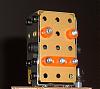
Now THIS is a big block...
Apex Paul is offline   Reply With Quote
Old 07-26-2010, 09:47 AM   #24
big hammer

 
Drives: 2002 ws6
Join Date: Jul 2009
Location: manitoba
Posts: 1,202
Quote:
Originally Posted by AZCamaroFan View Post
simply put it's the size of the engine block. A 409 and a 283 were completely different engines, with different size blocks. Same for the 327 and 427. The 454 was the last of the 'big blocks' at Chevrolet. The 427 in the current ZO6 Corvette is actually a 'small block'.
actually the 8.1L in the early-mid 2000's was the last production line big block.
__________________
Bolt on 2002 ls1 Trans am--- 11.5 @ 121 (1.72) 2000 da
big hammer is offline   Reply With Quote
Old 07-26-2010, 09:51 AM   #25
helmincamaro
Official Lounge BAMF
 
helmincamaro's Avatar
 
Drives: '97 Camaro
Join Date: Oct 2009
Location: Kannapolis, NC
Posts: 13,576
Send a message via AIM to helmincamaro Send a message via Yahoo to helmincamaro
Quote:
Originally Posted by Apex Paul View Post
My understanding is that Bore separation (spacing) is the defining character for a big block. I should have been as clear as you were when I posted earlier.

Now THIS is a big block...

idk about you... but this is what I call a big block:


710 cubic inches per cylinder (20 cylinders).... so roughly a 14,200 cubic inch engine, oh and they come with single or twin turbos and push 6,000hp at around 950rpms. Just as a reference, I'm 6'-2" and if I'm standing with my feet level with the bottom of the oil pan.... I'd need a step stool to look eye level at the valve covers. Don't think about trying to fit it under your hood, it weighs over 16 tons.
helmincamaro is offline   Reply With Quote
Old 07-26-2010, 01:00 PM   #26
spyderbuddy


spyderbuddy's Avatar
 
Drives: 2010 RS Inferno Orange Metallic
Join Date: Mar 2010
Location: Albany, Ga.
Posts: 3,474
No man that is not a big block Thats a monster motor
__________________
2024 Camaro/Panther Emblem,Hot Wheels Emblems, Hot Wheels Door Sills and Floor Mats, Morimoto Fog Lights, PCP Hideaway Headlight Covers, BBK Headers & High Flow Cats, ZL1 Add-ons Wicker Bill, TL1/ZL1 Hood Insert, Gen5 DIY Frameless Mirror, ABL Dash Lighting & My link Navigation, Blacked out Rear Bowtie, all Sylvania led Turn Signals, Ceramic Window Tint By Nicks, MBRP Exhaust tips, GEN5 DIY Virginia Legal DRL Harness, Painted Brake Calipers, Vittesse Throttle Controller & Paddle Shifter Heritage Grill, Manual Shifter Boot, CNC Throttle Body, Trifecta Tune, Trunk Black out and Side Grills,
spyderbuddy is offline   Reply With Quote
Old 07-26-2010, 11:22 PM   #27
AZCamaroFan
Camaro6 2016-2018
 
AZCamaroFan's Avatar
 
Drives: sometimes
Join Date: Mar 2008
Location: Phoenix
Posts: 18,468
Quote:
Originally Posted by topgun1 View Post
I love the 454 engine. If I ever get a 69 chevelle SS, I want that engine in it!

thanks for all the info to all, but still....what are the actual specifications that make a block a "big block"? is it a very blurry line or a fine line--i.e. certain bore and stroke, certain displacement, liter, etc.
I'm not sure there are specifications. I think at the time the term came into use there were smaller blocks and bigger ones. Now they're all about the same size.
AZCamaroFan is offline   Reply With Quote
Old 07-27-2010, 01:13 AM   #28
DGthe3
Moderator.ca
 
DGthe3's Avatar
 
Drives: 05 Grand Am GT
Join Date: Jul 2007
Location: Niagara, Canada
Posts: 25,366
Send a message via MSN to DGthe3
Quote:
Originally Posted by AZCamaroFan View Post
I'm not sure there are specifications. I think at the time the term came into use there were smaller blocks and bigger ones. Now they're all about the same size.
They are, but its not because there is some new 'medium block' being used. There are no longer any big blocks being built by GM, and I assume Ford and Chrysler have stopped as well. They still make big block crate engines, but nothing comes from the factory with them anymore. Everything is based off small block architecture.
__________________
Note, if I've gotten any facts wrong in the above, just ignore any points I made with them
__________________
Originally Posted by FbodFather
My sister's dentist's brother's cousin's housekeeper's dog-breeder's nephew sells coffee filters to the company that provides coffee to General Motors......
........and HE WOULD KNOW!!!!
__________________

Camaro Fest sub-forum
DGthe3 is offline   Reply With Quote
Reply


Posting Rules
You may not post new threads
You may not post replies
You may not post attachments
You may not edit your posts

BB code is On
Smilies are On
[IMG] code is On
HTML code is Off

Forum Jump

Similar Threads
Thread Thread Starter Forum Replies Last Post
L99 how many cubic inch soonerfanru2 Camaro V8 LS3 / L99 Engine, Exhaust, and Bolt-Ons 14 01-16-2011 11:00 PM
500 cubic inch V8 into a 1973 Z28 VRMMMM 1st & 2nd Generation Camaros 0 05-23-2010 02:16 AM
Cubic Inch tnspd Camaro V8 LS3 / L99 Engine, Exhaust, and Bolt-Ons 2 12-29-2009 12:48 PM
What cubic inch BLU BY U Camaro V8 LS3 / L99 Engine, Exhaust, and Bolt-Ons 5 11-24-2009 12:23 AM


All times are GMT -5. The time now is 06:34 PM.


Powered by vBulletin® Version 3.8.9 Beta 4
Copyright ©2000 - 2025, vBulletin Solutions, Inc.