Quote:
Originally Posted by KMPrenger

Maybe so...
But come on now. First VW, then FCA getting hit with the same (or very similar) accusations, and now GM?
Am I the only one that thinks its a bit unbelievable that all of these major automakers would all cheat at this?
The report says that they all use some sort of cheat device to beat the testing. Except that, these devices can be legal under "certain circumstances". OK...so what is that?
Also, I found it interesting that the report indicated that Bosch was the company behind the programming/electronics for all three above cases...VW, FCA, and GM. So is Bosch also involved, or responsible for the "cheating"?
|
So, here is the deal - it is illegal to implement "emissions defeat devices" as part of the vehicle's engine management systems. The EPA cracked down on "highway mode" in heavy-duty diesel engines in the late 90s and made it very clear that it is not legal to detect a particular operating condition that occurs outside of testing and intentionally defeat any part of the emissions control system. Clear, right?
Well, then we have cases that occur outside of the strict "drive cycles" (lab tests) where we may need to alter an engine's emissions performance to avoid damage. If the coolant or ambient air temperature is abnormally cold or hot, or if a catalyst is determined to be excessively hot, or if a component has failed, then it is acceptable to
temporarily alter emissions performance for the sole purpose of protecting the engine and emissions controls system. Maybe we alter fuel injection volume and typing, or discontinue the use of EGR, or avoid regen events, or any number of other things that we wouldn't typically do during normal operation. On gas engines, we might see that the air-fuel ratio goes pig-rich when the coolant is excessively hot, or that we retard timing if the fuel quality is poor. That's perfectly legal.
What VW did was as clear as can be - they broke the law by designing software that discriminated between the lab and the real world, and then engaged in a broad conspiracy to cover up their illegal behavior. This is as black-and-white as it gets.
The FCA case appears to be a bit less cut-and-dried. The EPA has accused the company of implementing several emission defeat devices that alter the performance of various emission control systems based upon vehicle operating conditions, but it isn't quite so simple as "detect that the vehicle isn't on a dyno and turn everything off". I suspect that there was a deliberate attempt to exploit grey areas of the regulations, but this case might be as much about FCA's unwillingness to roll over as it is about the technical nature of the alleged wrongdoing.
GM has not yet been accused by the EPA of any wrong-doing; the lawsuit was a civil case filed by a group of lawyers. I have not yet seen what evidence they are presenting, other than allegations that certain GM diesel pickups exhibit "in-use" emissions (those measured while the vehicle is being driven on an actual road, not on a test lab dyno) that exceed the federal limits for drive cycle testing. Guess what? Most every vehicle does the same thing, since the lab tests don't do a great job of replicating typical driving. Here is the "US06" drive cycle, which is by far and away the most aggressive:
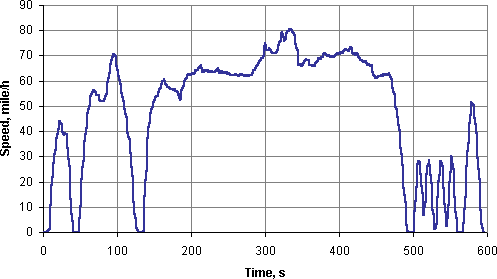
If you accelerate even modestly quicker than the values shown on this graph, then you will likely see higher loads and thus higher emissions. If you run this cycle at temperatures hotter or colder than the ambient temp used for the lab tests, you may get higher emissions. If you run this into a headwind or up a grade, you will get higher emissions. This is why we test in a lab - to remove variables.
Until the EPA alleges illegal behavior by GM, I do not feel this case has any merit.
With regards to Bosch, they are the industry's leading and largest supplier of engine management hardware and software, so it's not surprising that they are involved with all of these cases. That alone does not indicate wrong-doing. The fact that they supplied "test" software isn't by itself an indication of wrong-doing, as such software is potentially beneficial during development. All that being said, I find it very difficult to believe that they didn't know of any misuse of their technology by their customers, as I would fully expect that they would run tests on production cars to determine the performance of their products in the real world. If nothing else, the performance of VW's products relative to every other manufacturer of similar vehicles would be reason enough for a big supplier to investigate further. We'll see what comes out in court.