Quote:
Originally Posted by Banshee

The doppler units are fixed on the front dash and rear deck of the car..used for in motion speeders. There are handheld radar units...but you have to be stationary...or a damn good driver!
LIDAR is handheld.
This is radar...see the two cylinders? one mounts in front, one in rear..dash and rear deck. I will take a few pics of my car tonight and show how set up.
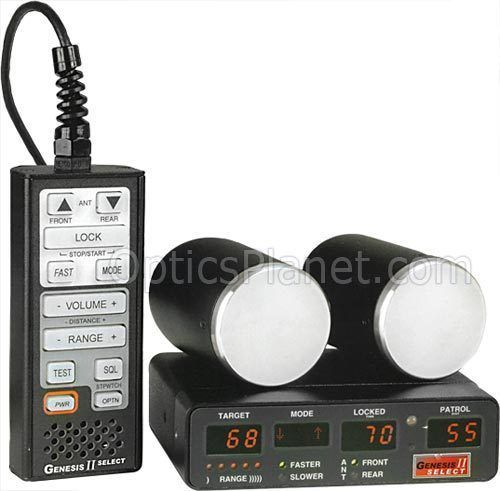 |
The radar displayed here is a Decatur Genesis II Select which will clock vehicles approaching with front antenna or going away with the rear antenna while the patrol car is moving. This unit will also clock from a stationary position using either antenna. In Pa only State Troopers are allowed by law to use Radar and most of those I saw were hand held stationary units. There are several other brands of radar such a Kustom Signal, MPH, and Stalker that have the same capability as the newer Decatur Genesis II Select which I last used before I retired. These newer Radars have the capability of clocking vehicles in the moving mode going the same direction as the Police car. The Officer can be following a vehicle and obtain a clock or can clock a vehicle coming up from the rear. The current Lidar/Laser (LIght Detection And Ranging) are all stationary but very effective in picking out a vehicle in heavy traffic. VASCAR is very effective tool and can be used while moving or stationary. The VASCAR is passive (won't trip radar/Lidar detectors) and works off of distance divided by time. At highway speeds its recommended to use at least 1/8 mile (660 FT) or a 6 second minimum clock. The newer Radars and Lidar units can also be used in a passive mode with a known distance where the operator times the vehicle between two points to obtain the vehicles average speed. In my area all of these methods are used in conjunction to Aircraft and pacing where an Officer will follow a vehicle and match the patrol car speed (certified speedometer) to the vehicle being followed. All of these methods are effective but each has its own advantage and disadvantage usually associated with cost and training. The most common problem I encountered with violators was that they really didn't know when or where they had been clocked. The Officer may have clocked the vehicle before the driver ever saw the Officer or Patrol Car. One significant problem for the Officer is to make sure he is stopping the car he clocked. In heavy traffic and at night this can be a problem but If I was never sure I had the right car I wouldn't even stop it. There is always next time for the Officer and my integrity was worth more to me than anything else. Most newer vehicles have speed sensors which has improved the reliability of the cars speedometers. If you change the size of tires from 205/70R15 to 255/70R15 this can effect the reading by several miles per hour. The diameter of the 255 series tires are greater and the tire is making less revolutions per given distance. The faster you drive the greater the error of the speedometer. The same problem can occur if you change transmissions and don't verify the speed sensor or gear is correct. Unfortunately for motorist its not the Officers responsibility to figure out why your speedometer doesn't match what he clocked you at. A lot of times I could tell there was a problem and tried to help the motorist understand what the problem was so they wouldn't get stopped again. Unfortunately an Officers can't always tell if there is a problem or have time to help the motorist. I tried to treat every motorist the same and my in-car video tapes would reflect this however the way a Driver acted could also effect whether they got a warning or a citation. Being a Police Officer always involves conflicts and some Officers are better at resolving conflicts better than others.
