Callaway C16
When even a Corvette isn’t enough, call Reeves
By MARK VAUGHN
AutoWeek | Published 03/12/07, 3:22 pm et
AT A GLANCE:
2007 CALLAWAY C16 CHEVROLET CORVETTE
AVAILABLE: Now
PRICE: $120,000 base, $192,000 as tested
DRIVETRAIN: 6.0-liter, 616-hp, 582-lb-ft supercharged V8; rwd, six-speed manual
CURB WEIGHT: 3375 lbs
0 TO 60 MPH: 3.3 sec (mfr.)
FUEL ECONOMY (EPA COMBINED): 22.5 mpg
What could a Corvette owner want that’s not already in the fabulously fast standard-issue General Motors Chevrolet product? Fer cryin’ out loud, the thing’s already got 400 hp in base trim and a whompin’ 505 hp as a Z06. And since it weighs just a little more than 3000 pounds wet, it can spank the decals off almost anything that lines up against it. What more could any sensible Corvette luster seek?
More everything, that’s what.
Callaway has been giving Corvette owners just what they love and lust after for 20 years, and non-Corvettes for another 10 years before that. Reeves Callaway started in his garage in Connecticut in 1977, making turbochargers for various performance cars. Then, in the late ’80s, a particularly well-done Alfa supercharger caught the eye of Corvette chief engineer Dave McLellan. That led to the fearsome twin-turbo Callaway Corvettes of 1987-91, including the all-conquering, 254-mph, twin-turbo Sledge Hammer. From that slobbering beast came the SuperNatural LT1-based naturally aspirated Corvettes (AW, Jan. 25, 1993), followed by the C12 homologation cars that allowed Callaways to race at Le Mans and now this, the C16.
Bill Delaney
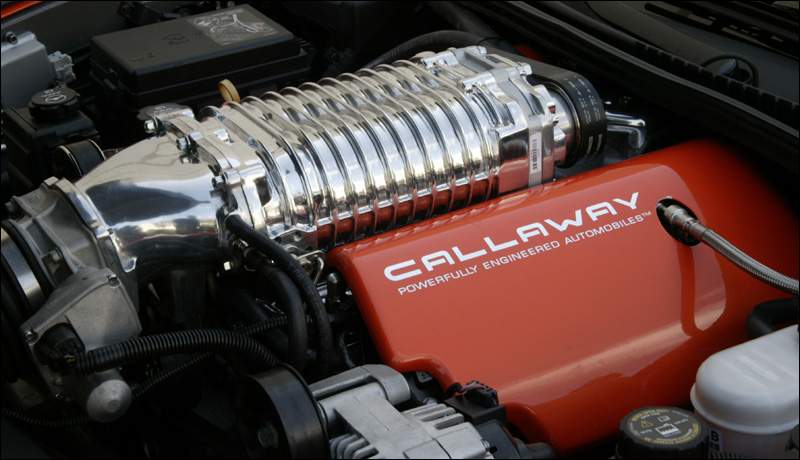
Callaway supercharged GM's 6.0-liter aluminum-block V8 to boost output to 616 hp and 582 lb-ft of torque.
The 16 in its name does not refer to cylinders, as many people who saw our test car assumed, but to the car’s spot in Callaway history. This is the 16th project to come out of the Old Lyme, Connecticut-based supercar maker. Given the marque’s powerful history, this one is a somewhat more subdued version, if you can use the word “subdued” in the same sentence as “616 hp.”
The heart of the Callaway conversion is an Eaton/Magnuson roots-type supercharger that bolts nicely on top of the 6.0-liter aluminum V8 Chevrolet engine (a kit for the 7.0-liter Z06 is in the works). The engine has the same 4.00-inch by 3.62-inch bore and stroke, and it wasn’t necessary to change the compression ratio. Callaway also adds higher-flow injectors. That gets horsepower up to 560 at 6200 rpm and torque to 500 lb-ft at 4750 rpm.
That’s for the base C16, which you could glibly call C16 Lite. But the base C16’s 560 hp is probably not going to be enough, is it? So Callaway has an option package that adds unique cylinder heads, larger intake and exhaust valves and Callaway-specific rocker arms and pushrods, all of which bring power up to 616 hp at 6200 rpm and torque to 582 lb-ft at 4750 rpm.
Bill Delaney
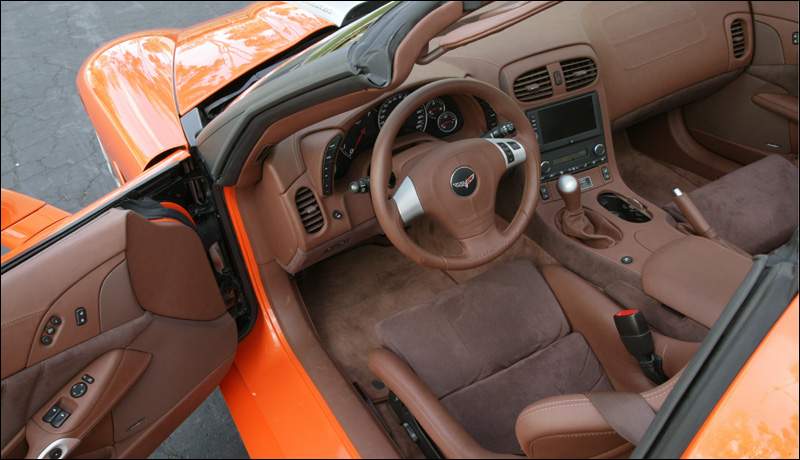
The spartan interior of the stock C6 is extensively retrimmed for use in the C16.
It’s not at all unmanageable. With only 7.5 psi of boost max, Callaway didn’t even have to rebuild the bottom end of the motor.
“It’s not a big stress on the components,” said Pete Callaway.
Yes, there’s a Pete Callaway, son of Reeves. He started working in his dad’s shop at age 11 and is now West Coast rep for Callaway Engineering, setting up Chevrolet dealers to service and sell C16s. Like his dad, he is tall, polite, soft-spoken and knowledgeable, not at all what you’d expect of a “tuner” proffering 616 hp of anything.
He gave us a walkaround of the car outside the Callaway family compound deep in the heart of Orange County.
“The C12 was the total package. You could only get one trim level, and that had everything on it,” he said. “With the C16, you can do just the brakes or just the suspension or whatever you’d like. The C16 is essentially a menu for all the components.”
There are a lot of components.
For brakes, you can leave the standard Z51 four-piston calipers that GM puts on Corvettes, or you can upgrade to Callaway six-piston front and four-piston rear grabbing 355-mm by 32-mm discs.
The suspension is a collaborative effort with Eibach. You still have the SLA upper and lower A-arms and transverse leaf springs, but Callaway added double digressive shocks and Eibach springs. The dampers adjust 10 ways for jounce and 10 ways for rebound, allowing you to come up with a track setting and a commuter setting, for instance. Ride height adjusts more than 2 inches.
“We bring the spring rate up a little bit,” said Callaway.
Our test car rode on Michelin Pilot Sport 275/30ZR-19s front and 325/25ZR-20s rear, mounted on Dymag wheels with magnesium centers and carbon fiber outers. Callaway is working with Yokohama on a 345/25 for the rears that should be available in early 2008.
Bill Delaney
The C16 feels tighter, stronger and faster than a stock Corvette, yet it's still easy to drive in commuter traffic.
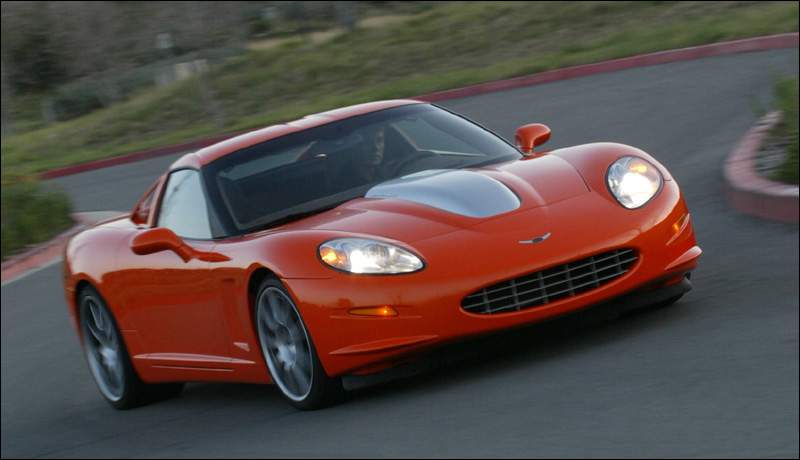
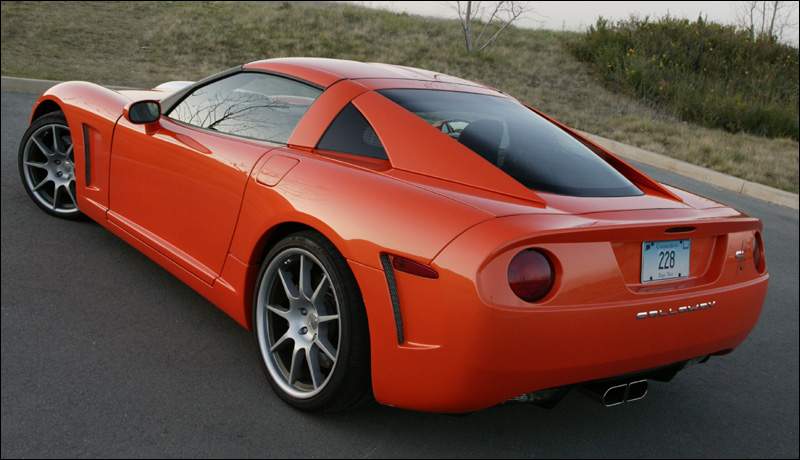
The entire car is wrapped in the wild Tangelo from House of Kolor fiberglass bodywork you see here, though you don’t have to get orange. The only original exterior parts are the roof, decklid and mirrors. Everything else is all Callaway, from the big hood bulge to the uniquely subtle strakes that form faux C-pillars in back.
On the road, the C16 immediately feels even tighter, stronger and faster than a stock Corvette. It’s everything buyers love about that car and more. While roll, dive and squat are mighty hard to sense in a standard Vette, they’re almost entirely absent in a Callaway. And yet the extra power and torque are there anywhere on the tach, especially from launch.
Our car had the optional racing seat, awkward to get into but one of the most comfortable and secure buckets we’ve ever sat in.
Just as with the regular Corvettes, this one was easy to drive in typically lousy commuter traffic, even easier since the one-to-four shift lockout had been disconnected mysteriously in our car.
It would have been fun to tabulate lap times back-to-back between our 616-hp C16 and a Z06 straight from Bowling Green. But a tough schedule meant only a single afternoon in the Callaway and no time for a Corvette loaner from Chevrolet. We have no doubt the C16 would hold the edge, but it sure would have been a fun day finding out.
If you own a Z06, we suggest buying one of these, too. Then send us your results.
Callaway is taking orders now and needs about two or three months’ lead time. Order now (
www.callawaycars.com), and yours should be ready for track days once spring rolls around. Prices are about $190,000 total for a fully loaded honker.