Quote:
Originally Posted by radz28

OOOOOO!!! A tech' post!!!! 
As far as those rods - I think GM went with the Ti rods in LS9 for their weight, perhaps, more than because of their strength. They wanted lighter weight to get the revs' higher, and lighter rods enabled that, along with the other tricks they used to control the valvetrain. Isn't Ti more briddle than steel? That's not entirely desirable in all automotive applications, is it? I believe aluminum is desirable because they take the shock from N20 better, no (for example)? |
Titanium is only brittle when cold (below room temp) when its heated (not over 430 degrees) it inherits alot of steels properties as far as working with it. Titanium is usually just as strong as steel but requires less metal to accomplish what steel does... It weighs about half of an equal amount of steel does. Titanium would be ideal in some areas, but rods and valves are very good places to use it.
Quote:
|
Pistons - people seem very quick to take away any qualities of these hyper' pistons. It's like many automatically think they're the same as the "standard" LS3/L99 pistons, and they're not. In addition - the oil squirters are also going to assist those stay together more effectively. But don't both LS9 and LSA pistons have the coatings on the skirts?
|
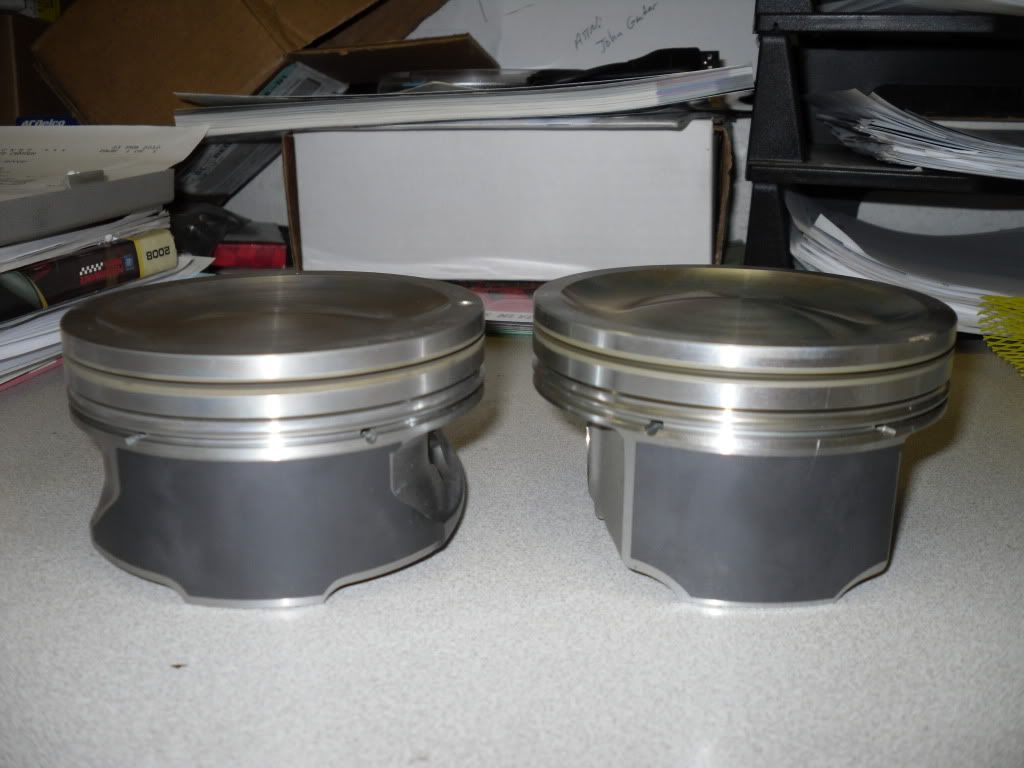
LS9 pistons are coated and actually have more coating then the LSA's. However, the LSA survived longer in a durability test for about 150-200 hours longer. The reason being mostly because of the high cylinder pressure and HP/TQ output more than piston quality... regardless, the LSA last longer... The LSA's cast pistons use alot of the newer piston casting/forged techniques that the high cost forged applications do. There is nothing wrong with Hyper-E pistons, but when people are producing 650 rwhp and then complain that they blew a piston its not the quality of piston that caused the failure, its the quality of the person who made that decision. Pistons below, LS9 left, LSA right
Quote:
|
SC - would it be possible that the 10.5 psi in the 2300 is necessary to produce the 80 more horse' and overcome inefficiencies in the packaging for LS9 in ZR1's body? I know they had to go to great lengths to keep the hood height low enough for visibility through the windshield which meant they really had to squish the SC and plenum down. Looking at the intercooler bricks on LS9, it's easy to see air is forced to change direction and shape to conform to the passages, IMVHO. Do you think this could have an effect on boost, since it is a reflection of restriction?
|
Both of these systems should be a closed air to liquid cooling systems and the superior efficiency of the TVS makes any small downfalls laughable. Air restriction in the dual brick would be a very small restriction and would think that heat distribution of a dual setup would balance out any flow issues. Just because the ZR1 uses a dual brick doesn't mean the ZL1 has to. a S/C specialist could answer this better than I could...
Quote:
|
I think the CTS-V car is running an NA LS3-type engine, isn't it?... I don't know - that's why I'm asking
|
I was asking because I didn't know, but I thought that it WAS S/C'd.
Quote:
|
I like the rest of the specific points you make about the powertrain and chassis, too. The engine can make all the power in the world, but it won't matter if the chassis can't take it and use it.
|
There are transmission options available and gearsets can easily be changed... I need to look alternate drivetrain set ups. What sucks for GM is that Ford never released anything on the Coyote long stroke and it was kept very hush after 2009. It would be a stab in the dark... kinda like the 60's again...